
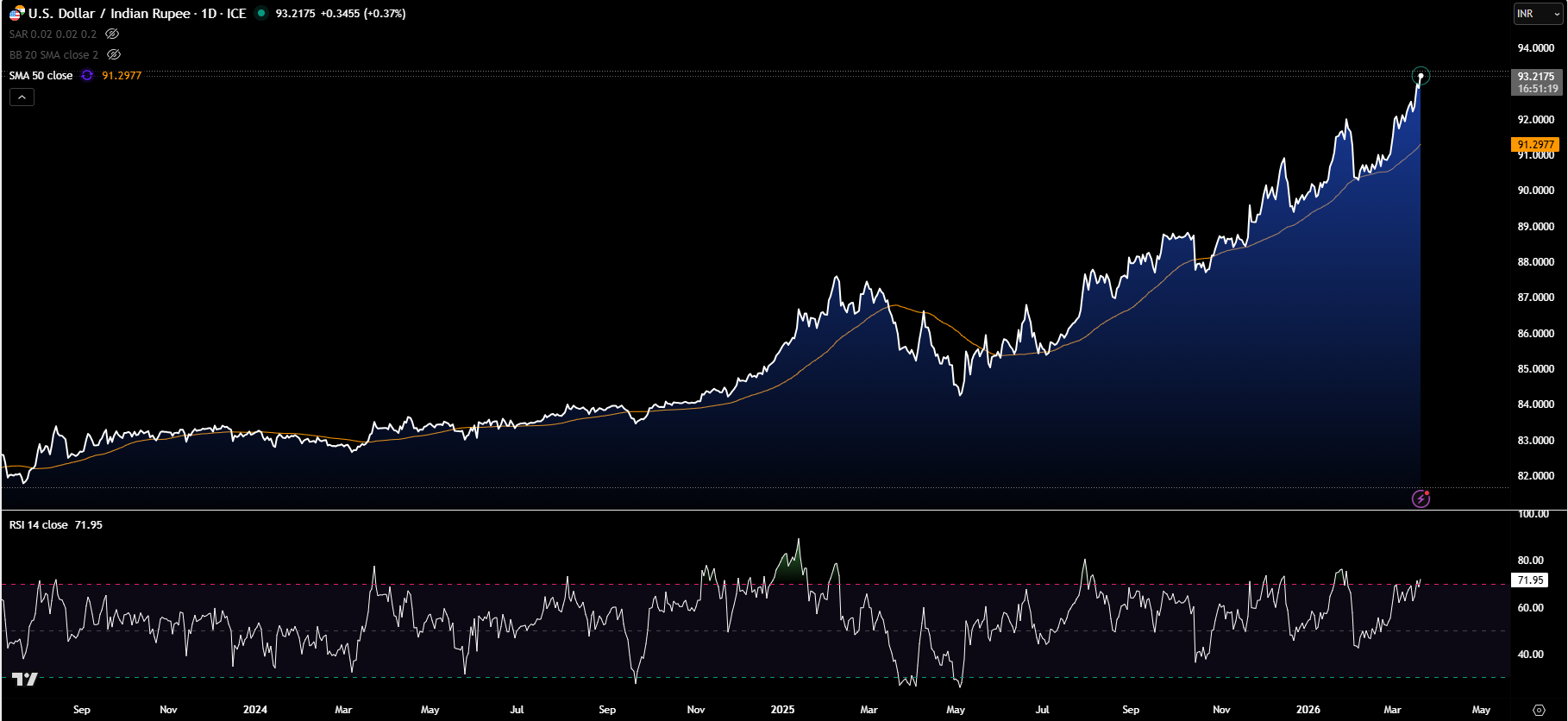
The Indian Rupee breached the 93 mark against the US Dollar this week, recording an all-time low on March 19, 2026. This is not merely a round-number headline. It is the convergence of a geopolitical supply shock, a deteriorating external balance, and an equity market that is repricing risk in real time. For participants across asset classes, the implications are material and worth examining without hyperbole.
The Structural Backdrop
The Rupee entered 2026 already on the back foot. After depreciating roughly five percent through 2025 amid record foreign institutional selling, the currency opened the year near 89.65 and drifted steadily higher on the USDINR cross. The move from 90 to 93 in barely ten weeks, however, is a pace of depreciation that exceeds normal cyclical drift. It reflects something more disruptive.
That disruptive force is, overwhelmingly, the ongoing conflict in West Asia. The US-Israeli military strikes on Iran, commencing February 28, triggered Iran’s effective closure of the Strait of Hormuz; the narrow waterway through which approximately twenty percent of the world’s crude oil and a substantial share of global LNG trade normally transits. Tanker traffic through the strait has collapsed from over 150 daily transits to a trickle. Brent crude surged from approximately $70–72 per barrel before the conflict to well above $110, with intraday prints approaching $126 at the peak. The Indian crude oil basket, which had traded comfortably in the $62–70 range for much of FY 2025-26, spiked to $146 per barrel as of March 18.
For India, an economy that imports over eighty-five percent of its crude oil, with roughly half historically transiting through the Strait of Hormuz, this represents a terms-of-trade shock of the first order.
The Macro Transmission Mechanism
The chain of causation is well understood but bears restating in the current context. Higher crude prices widen India’s trade deficit and current account deficit simultaneously, creating persistent demand for dollars from importers. Morgan Stanley’s widely cited framework estimates that every sustained $10 per barrel rise in oil prices reduces India’s GDP growth by 20 to 30 basis points and widens the current account deficit by 50 basis points. With crude having moved roughly $40–45 above pre-conflict levels, the arithmetic is sobering even if the shock proves transient.
There is already another revision India’s GDP growth forecast for FY26 downward to 6.5 percent from 7.0 percent, raised its inflation estimate by 30 basis points, and projected the current account deficit to widen by 0.8 percentage points. These are not alarmist projections; they are base-case recalibrations that reflect the magnitude of the energy price dislocation.
The Reserve Bank of India has responded with arguably the most aggressive intervention campaign in its history. Its net-short dollar position, a measure of forward dollar sales across onshore and offshore markets, is reported to be approaching $100 billion, dwarfing the previous record of $88.8 billion set in February 2025. The RBI sold an estimated $18–20 billion in a single week in mid-March. This intervention has succeeded in smoothing the path of depreciation, but it cannot reverse the underlying macro forces. Central bank intervention is inherently a rearguard action when the current account is deteriorating and capital flows are turning adverse simultaneously.
The Equity Market Impact
The stock market has not been a passive observer. The Nifty 50 has declined approximately 11 percent year-to-date, entering technical correction territory in March. The Sensex has shed over 10 percent. Foreign portfolio investors have withdrawn over $8 billion from Indian equities in March alone, averaging roughly Rs 6,400 crore per session; a pace that, if sustained for the full month, would rival the worst outflow episodes in India’s capital market history. In the first three months of 2026, cumulative FPI outflows have already reached 54 percent of the total outflows recorded across all of calendar year 2025.
The sectoral damage is concentrated in financials, which account for roughly one-third of the Nifty’s weight and have absorbed approximately 60 percent of total FPI selling. Banks have fallen by over 11 percent in the first half of March. IT services, sensitive to US growth expectations and dollar-denominated billing, have also seen meaningful de-rating.
What makes this correction structurally significant is the self-reinforcing loop at work. This loop of falling equities prompts further FPI selling, accelerating rupee depreciation, eroding USD-denominated returns for foreign holders, and, in turn, discouraging fresh inflows. Breaking this loop requires either a resolution of the geopolitical shock or a valuation reset deep enough to attract fresh capital, or both.
What to Watch
Several signposts will determine whether the current stress remains a manageable adjustment or metastasises into something more damaging.
First, the duration and resolution of the Strait of Hormuz disruption remain the dominant variable. India’s diplomatic efforts — evidenced by two Indian-flagged LPG carriers transiting the strait with Iranian permission around March 14 suggest pragmatic engagement is underway, but these are limited exceptions, and cannot be contrued as reopening.
Second, crude oil trajectory matters enormously. If Brent sustains above $100 for a quarter, the fiscal and current account damage will be difficult to contain without policy intervention beyond FX reserves alone.
Third, it is widely expected that USDINR could reach 94–95 by the first quarter of 2027. These are not outlier estimates; they represent the emerging consensus.
Fourth, India’s domestic institutional architecture, particularly systematic investment plan flows into mutual funds, has provided a counterweight to foreign selling. Whether this domestic bid holds firm as the rupee weakens and inflation expectations rise will be a critical test of market resilience.
Concluding Assessment
The Rupee at 93 is not a crisis in isolation, but it is a clear signal that India’s external vulnerabilities have been laid bare by a geopolitical shock that the economy is structurally ill-equipped to absorb painlessly. The confluence of surging crude, a near-closed Strait of Hormuz, massive FPI outflows, and aggressive but ultimately finite RBI intervention creates an environment where the path of least resistance for the currency remains weaker in the near term. For equity markets, the repricing is rational given the macro deterioration, though the speed of the correction may eventually create entry points for patient capital with a longer time horizon.
The coming weeks will be determined less by domestic policy and more by the trajectory of the conflict and the global energy market’s ability to find alternative equilibria. Until that clarity emerges, caution is warranted.

Navigate Volatile Markets with Clarity. MarketPulse India combines rigorous technical analysis with actionable trade and investment ideas, exit strategies, and direct analyst access. If you are looking for disciplined, evidence-based research to guide portfolio decisions through periods of elevated uncertainty, explore how MarketPulse India can support your process.